
The best technical work often starts by building the right system, not by polishing the final surface.
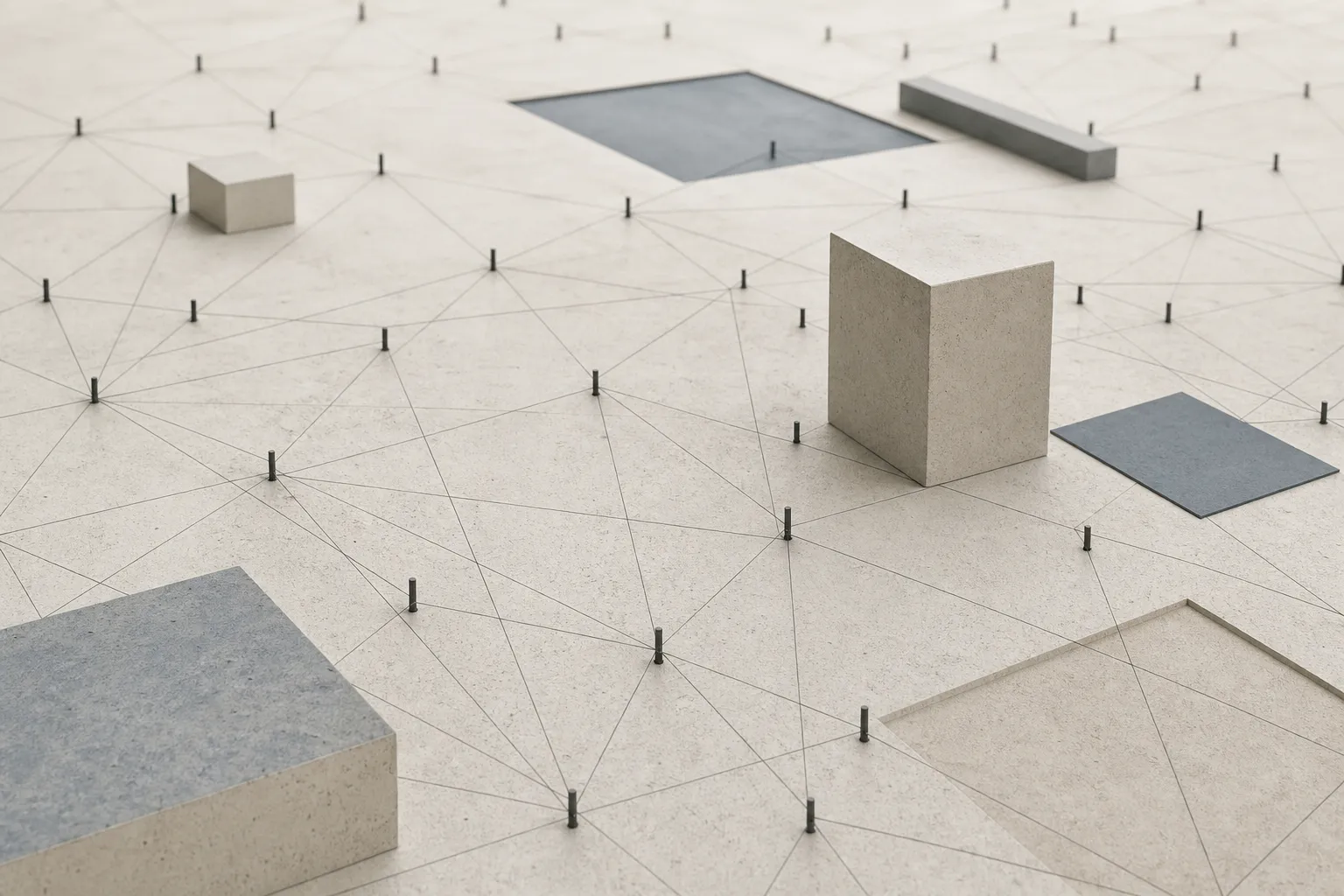
That is part of what the Sol LeWitt-inspired animation on the 4084 site is meant to show.
On the surface, it is a restrained motion piece. Points appear. Lines connect. A field takes shape. Then the form shifts in space with enough movement to feel alive, but not so much that it starts asking for attention it did not earn.
The idea is simple.
That simplicity is the point.
The reference is Sol LeWitt’s rule-based art, especially the logic behind instructions that can produce a rich visual result without turning the work into noise. Simple rules. Clear boundaries. Enough freedom inside the system for variation to matter.
Generative web motion works well under the same conditions.
You define the rules. You decide what can vary. You decide what must stay fixed. You pay attention to timing, contrast, density, motion, and restraint. Then you let the system produce the result.
This is where teams often get the work wrong.
They start with the effect they want to show, not the system required to make it behave well. The conversation moves straight to the finished asset. Make it feel premium. Make it more dynamic. Make it stand out. By the time the work reaches production, the idea is still vague and the implementation is carrying too much guesswork.
That is how digital features become expensive decoration.
A visual idea without rules usually creates problems downstream. The browser has to do too much. The motion has no clear stopping point. Responsive behavior feels improvised. Accessibility becomes an afterthought. Performance gets negotiated late. Capture and export become awkward because the team never built a stable way to explore the piece in the first place.
The better approach is plainer.
Reduce the concept until it can survive contact with the medium.
For this animation, that did not mean designing a static composition and handing it off as a fixed target. It meant building an internal page at /src/pages/dev/lewitt-field.astro to generate and tune the field itself. That tool gave the team a working instrument, not just a mockup.
Inside that page, the system could be tested as a system. Seed values could change. Motion could be replayed. Reduced-motion behavior could be checked. Density, timing, and shape behavior could be judged in a browser instead of guessed in a static design file. The team could explore variation, reject weak outcomes, and capture the version worth finishing.
That detail matters because it explains the larger discipline.
Good digital work often needs supporting tools before it needs a finished artifact.
Sometimes that tool is a content model. Sometimes it is a QA view. Sometimes it is a small internal app that lets a team test rules, tune an interaction, or generate usable source material. In this case, the internal tool made it possible to explore the idea properly and then render the final video with control over browser behavior, motion, and output quality.
That is not extra work around the real work.
That is the real work.
A lot of technical projects fail because nobody wants to stop and define the operating system behind the feature. The team keeps discussing surfaces. The feature list grows. The visual language gets busier. More effort goes into presentation than into the conditions that would make the result coherent.
The animation on the 4084 site is deliberately not doing that.
It is not there as filler. It is not there to prove that the team can make something move. It is there because the site needs a visual expression of how 4084 thinks: clear idea, clear rules, measured execution.
That still requires judgment beyond the concept.
The motion has to perform well. It has to behave across screen sizes. It has to respect reduced-motion needs. It has to work with the surrounding typography and pacing of the page. It has to justify its presence in the layout. It also has to know when to stop. Taste shows up in removal as much as addition.
That is another place where art and technical work meet in a useful way.
Not because a website should pretend to be a gallery piece. It should not.
The useful lesson is that constraints are not the enemy of expression. They are usually what make expression legible. LeWitt’s rule-based work understood that. Good interactive systems depend on it too. The more complex the medium, the more important it is to state the rules plainly and protect them from drift.
That applies well beyond animation.
It applies to websites that need clearer page logic. It applies to AI tools that need a defined job and review path. It applies to internal systems that need structure before automation. It applies to publishing workflows, data-driven experiences, and interactive features that sound ambitious in a meeting but collapse when no one has reduced the idea to a workable set of decisions.
This is where 4084 can be useful.
We can help define the concept, simplify the system, prototype the hard part, build the internal tool when the work needs one, and then finish the useful version. Sometimes the right answer is a polished public feature. Sometimes the right answer is the quiet internal mechanism that makes the public feature possible.
The practical next step is to ask one direct question before building the visible thing.
What system would let this idea be explored, tested, and finished with discipline?
If the answer is unclear, the concept probably is too.